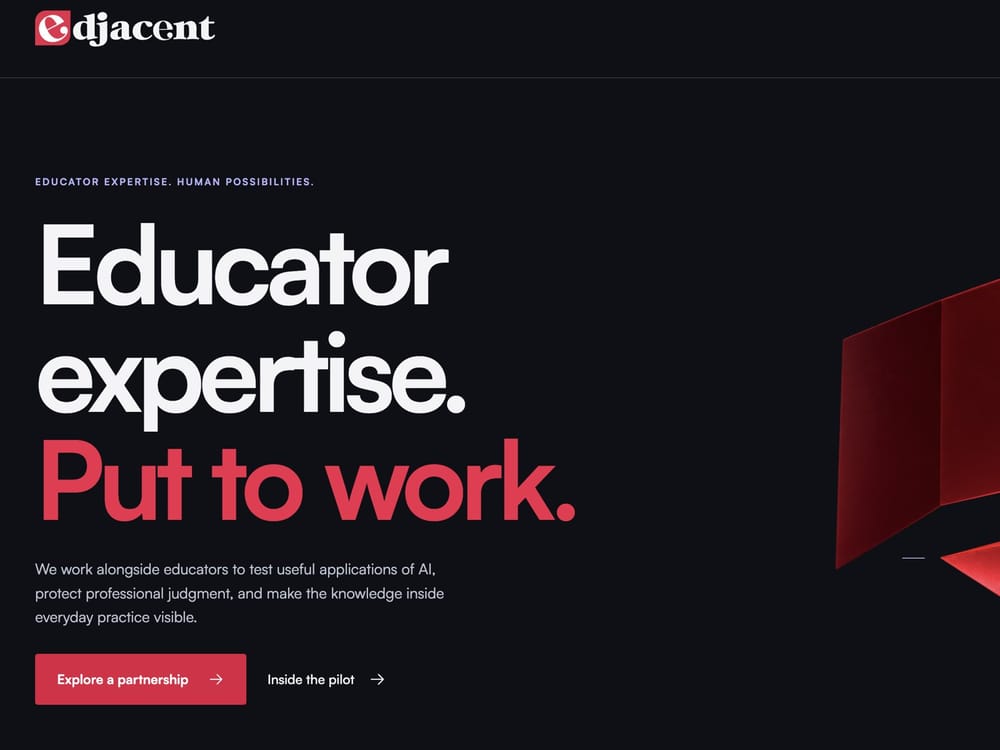
If you've visited edjacent.org lately, you may have noticed things look a little different. New colors. New words. A whole new reason for being.
Edjacent has been part of my story since 2020. It's been a community, a co-op experiment, a blog, a shop, a membership. Then it went quiet for a while. Now it's back, rebuilt around one idea I can't stop thinking about: the knowledge educators use every day is worth building on. Especially now that AI is in the room.
What Edjacent Used to Be
The first version of Edjacent was built for educators who wanted to do more with what they knew. Side projects. Micro-businesses. Ways to keep contributing after (or alongside) the classroom.
When I relaunched the site in the summer of 2024, I leaned all the way in: memberships, a shop, a co-op model for edupreneurs.
I loved the people that version brought together. Retired educators eager to serve. Instructional coaches. Writers with something to say. By the end, the blog held 129 articles. (I didn't count. The website did.)
And then AI showed up in every planning period, every inbox, every professional development agenda.
The question changed.
What Changed (and Why)
Over the past few months, I've been doing what I always do when I don't know the answer yet: talking to people. A first-year teacher. An experienced coach. A college professor. A homeschool instructor. Educators across very different settings, all figuring out what AI means for their work.
The ideas that lit people up weren't tools that would replace their thinking. They were tools that would honor it. Tools that start from what an educator already knows and does well, instead of handing them someone else's framework.
So that's what Edjacent is now. The new tagline says it plainly:
Educator expertise. Put to work.
We work alongside educators to test useful applications of AI, protect professional judgment, and make the knowledge inside everyday practice visible.
What an educator notices. The question they ask. The moment they change direction. That's expertise, even when it never makes it onto a résumé. (You know how I feel about résumés.)
A fun discovery in all this: the name still fits. Edjacent comes from the "adjacent possible": the next useful move that becomes visible when existing knowledge meets a new possibility. Turns out I named the thing right back in 2020. I just needed six years to grow into it.
How the Work Actually Works
Every project starts with the person and the work, not the technology. From there, four questions guide what we try:
- Automate: What could AI reasonably take off an educator's plate?
- Assist: Where can it help while the educator stays in charge?
- Protect: What should stay human? Relationships, consequential judgments, reading a room.
- Reclaim: What time and attention come back to the work that matters?
The process itself is a small, repeatable loop. Find the real problem. Try one useful change. Learn from what happens, including where the person had to step in and use their judgment. Then decide what (if anything) could travel to someone else's practice.
One thing I want to say out loud: technology is a choice. Some problems need a clearer process, a human conversation, or a shift in who gets to decide. AI is one option. Not the default.
The Founding Pilot
Right now, Edjacent's energy is going into a founding pilot.
One real problem. One small experiment. Six to eight weeks of real practice.
Participants work on something from their own day-to-day, keep brief reflections on what they tried and noticed, and debrief with us about what was useful, what wasn't, and whether any of it could inform a future tool or method.
We're carrying four big questions through the pilot:
- Where does AI help?
- Where does context change the answer?
- What depends on human judgment?
- What can another person learn from this?
The pilot is small on purpose, and it isn't open for enrollment. Build from evidence, not speculation. Early learning stays early learning, and we'll share what we find carefully and with permission.
Two Perspectives, One Practice
I'm not doing this alone. Kaman Hung is building Edjacent with me, and our strengths fit together nicely.
I bring educator relationships, pedagogical thinking, and attention to the context that makes an approach actually useful. Kaman brings AI and systems design, evidence gathering, and the practical experimentation that turns a promising idea into something we can test.
I've never fit neatly into one box. But I've learned which boxes I don't fit, and having a partner who lives in those makes everything better.
Where You Fit
The new site has two front doors.
If you work with an organization (building a product, designing a process, trying to understand what's happening in practice), you can explore a partnership. No polished brief required. Just describe the problem in your own words.
If you're an educator in a school, college, community program, or home learning setting, and there's something you keep noticing in your work, we'd love to hear about it. You can share your interest in future participation. It doesn't enroll you in anything; it just starts a conversation.
Either way, I'd encourage you to read our commitments first. There are six, and they guide everything from how we design experiments to how we credit contributions. The one I care about most: contribution stays connected. If your expertise shapes something that travels beyond your own practice, attribution, permissions, and fair terms are agreed up front. Not after.
And for the longtime Edjacent readers: the archive isn't going anywhere. All 129 articles are still there, kept in context.
Wrapping Up
The old Edjacent asked, What else could educators build?
The new one asks something quieter, and I think more important: What do educators already know that the rest of us need to see?
I don't have all the answers yet. That's kind of the point. One real problem, one small experiment, and then again.
Come take a look at the new edjacent.org, and if something sparks, tell me. You can also find Edjacent alongside my other work on my Projects page.