
What Changes Because This Badge Exists? Reflections from Badge Summit 2026
I came to Badge Summit 2026 with a lot to say. Four sessions in three days, new tools to share, and a team alongside me to make it happen. I left with more questions than I arrived with — and that's exactly what a good conference does.
What We Brought
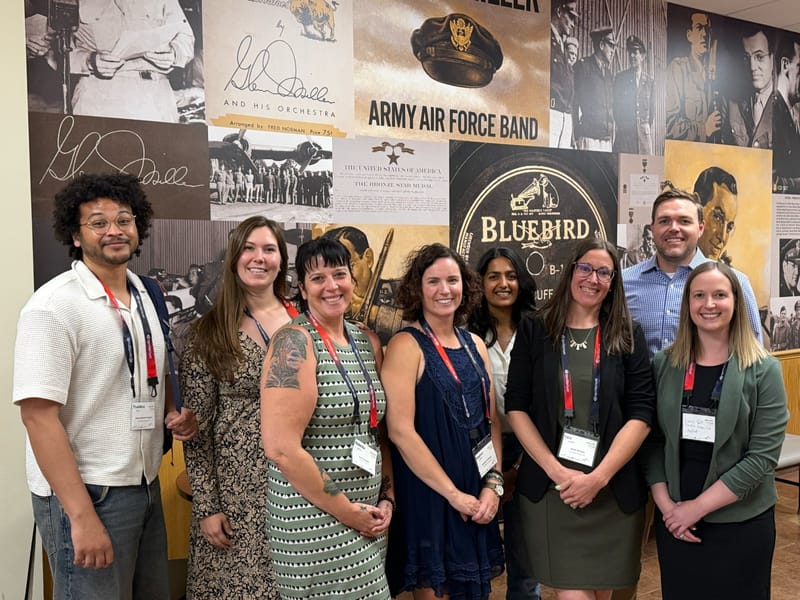
This year, the Education Design Lab team presented four sessions across the conference:
Where Skills Really Get Assessed: Mapping the Signals That Shape Opportunity — with Nishita Chheda, grounded in our Assessment Scan research. We mapped how skills are actually evaluated across hiring, onboarding, and advancement — and where the signals that practitioners trust most tend to go undocumented.
Making Experience Count in K–12: A Common Language for Internships, Capstones, and Career Stories — with Mason Pashia, building on our Experience Framework and the shared language we need to make work-based learning legible across systems and stakeholders.
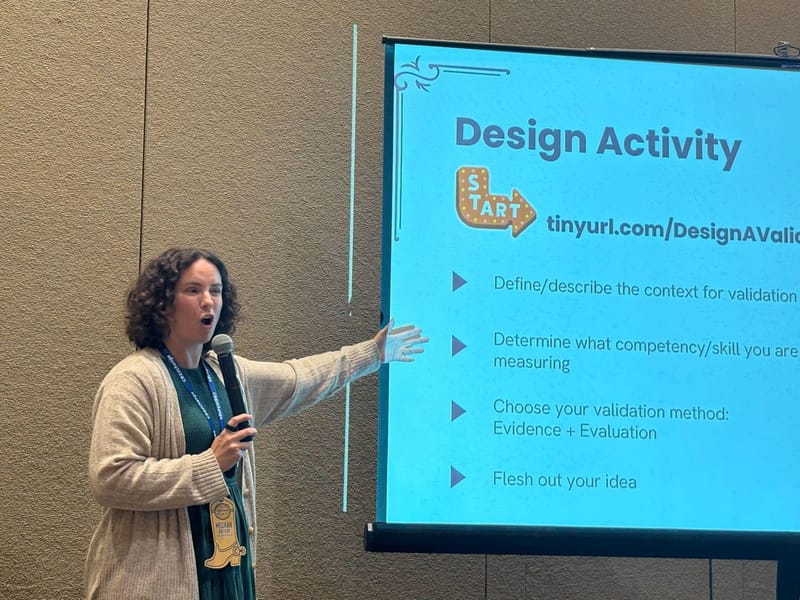
What Changes Because This Badge Exists? — a Dream Makers' Lounge Design Challenge I facilitated with Wilson Finch, who represented the Skills Validation Network with ease, warmth, and style. We used the Signal Check diagnostic to help practitioners apply a harder question to their own credentials: not "is this badge good?" but "good for whom, in what way, and under what conditions does it fail?"
An Assessment Scan session that got some excellent pushback and probing questions about how credentialing work connects to employers — the best kind. (Thank you, Amy Mendee.)
Presenting alongside this team — and with the full EDL crew of Tara Laughlin, Rebecka Ramos, Nishita Chheda, Thaddeous Gros Jr., Colin Reynolds, Elisabeth Fellows, and Laura Forst present and in the room — is its own kind of professional development. You don't really know what you think until someone asks you about it in front of a room. And you don't really know what your colleagues think until you watch them do the same.
What I Learned
The sessions I attended were just as rich as anything I presented.
Chris Newlon's session on credentialing civic participation cracked something open for me. We spend so much of our time in this field focused on economic outcomes — jobs, wages, mobility. What Newlon named, and what Jeaneen Kappel's ideas about Ruritan clubs brought into relief, is that badging for civic engagement can also be a pathway to the kind of overall wellness and community connection that economic metrics miss entirely. That's a frontier worth taking seriously.
Keisha Katz's keynote gave us something we don't get enough of: a true story. How badging came to be in the media sector, what it's doing for young people who don't have the relational capital to get noticed in that space, and where the gaps still are. Hearing a practitioner tell the real story — not the sanitized version — is always the most useful thing you can do at a conference.
Javier Motta-Mena gave a preview of a project I genuinely love — using digital credentials to support neurodivergent learners through self-disclosing allyship. We have a podcast conversation coming, and I'm looking forward to getting deeper into the learning design and the results.
Nishita Chheda (yes, also my co-presenter — she had a conference) ran a session on testing mobility that surfaced assumptions in our own work I hadn't fully named yet. The focus on STAR well-being as a frame for measuring what actually moves the needle felt like an unlock I'll be sitting with for a while.
Preston Trebas and Penny Ramirez from WGU gave one of the most beautifully organized presentations I've seen in a long time — on a genuinely important topic: trusted and transparent credentials in higher education. I also left that session having connected with a clown school graduate. Badge Summit contains multitudes.
And Courtney Lang made me think hard about rubrics — one of my favorite topics — in a way that was clarifying rather than just confirming. Those are the conversations worth seeking out.
On Noah and the Room
Badge Summit is hosted by Noah Geisel, and I don't know how else to say it: he is the consummate host. Sidewalk chalk directing you from session to session. Killer stickers. Thoughtful programming with flexible pacing and real space between sessions to actually talk to people. The connections you make at this conference are not accidental — they are the whole point, and they take an enormous amount of behind-the-scenes effort to enable.
Noah, I still want to introduce you to Nick Gray someday. And I expect that shortbread cookie recipe.
The connections I'm carrying forward from this year: Jeremy McQuigge, who has great ideas for how the Experience Framework can be used in Ontario to scale work-based learning. Marilys Galindo from Digital Promise — one of my earliest micro-credential connections, and reconnecting with her always reminds me how long and how well this community has been building. Christina Goldsmith, who helped us find some important next steps for an ongoing durable skills open resource project that's been waiting for them.
What I'm Taking Back
Three things I'm carrying forward:
Outcomes, not just badges. The conversation is shifting — from "did they earn it?" to "what changed because they did?" This is the new frontier of our evaluation work, and I'll be looking for it everywhere, including in how I report on our own projects. (More on the Signal Check tool soon.)
International and indigenous perspectives on badging. I left curious in a direction I haven't fully explored. What can the current badging movement learn from indigenous models of credentialing knowledge and community standing? I don't know yet — and I'm already thinking about professional travel to find out.
A new vision for skills visibility at EDL. This one is internal, but it's the most immediately actionable. I'm thinking about how we improve our own practices — operationally and across the projects we serve — so that skills visibility isn't just a topic we work on, but something we live inside our own organization.
Until next year, Badge Summit.
Education Design Lab is a national nonprofit that co-designs education-to-workforce models through human-centered design. Learn more at eddesignlab.org.