
My current projects, and things I'm working on.
The Team in STEAM
Proud to share The Team in STEAM: Integrating Disciplinary Practices into Project-Based Experiences in The Transdisciplinary STEAM+ Journal https://lnkd.in/eN4p6Fmp along with Dr. Margaret Borden, Dr. David Reese and Michelle Richter on behalf of Defined
The Team in STEAM: Integrating Disciplinary Practices into Project-Based Experiences" (MS #1312) has been published to The Transdisciplinary STEAM+ Journal. https://scholarship.claremont.edu/steam/vol6/iss1/10
Mapping the STEM Microcredential Landscape, Volume II
I co-authored a piece in a new book Mapping the STEM Microcredential Landscape, Volume II: Applied Case Studies and Future Perspectives (Educational Communications and Technology: Issues and Innovations) with my Education Design Lab colleagues Tara Laughlin and Nishita Chheda.
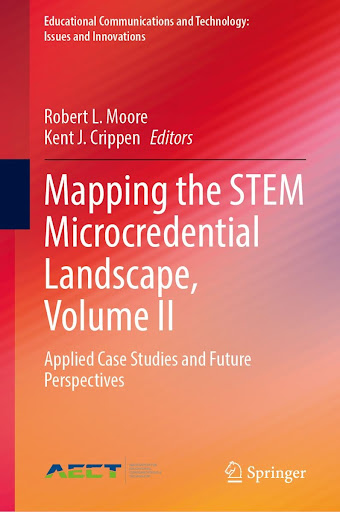
Our chapter is called: The Trust Factor: Skills Validation as the Cornerstone of STEM Microcredentials.
Here is the abstract:
The rapid evolution of STEM industries necessitates educational and workforce systems that are flexible and responsive. Microcredentials have emerged as a promising solution, yet these credentials often lack the trust needed to serve as credible hiring signals. This chapter argues that skills validation – the process of verifying that an individual possesses specific, demonstrable competencies – is the missing link in unlocking the full potential of STEM microcredentials, enabling equitable, effective, and accessible pathways into STEM careers. Drawing on Education Design Lab’s Skills Validation Market Scan and extensive stakeholder research, the chapter proposes a framework of diverse validation methods that extends beyond traditional assessments and better reflects the myriad of ways skills are developed in the real world: through formal education, work, and life experience. We emphasize the importance of co-designing validation solutions with stakeholders, particularly employers, learners, and workers, whose insights ensure relevance and inclusivity. Through interviews, surveys, and pilots, this chapter presents data and insights that underscore the impact of this collaborative approach. Ultimately, the chapter shows how skills validation can increase equity and strengthen hiring confidence, transforming microcredentials from potentially superficial signals into trusted indicators of workforce readiness, reshaping how STEM talent is recognized, developed, and hired.
Boosting the Signal on Microcredentials
I am in the final stages of submitting an article with my former co-author and colleague Eric Carbaugh.
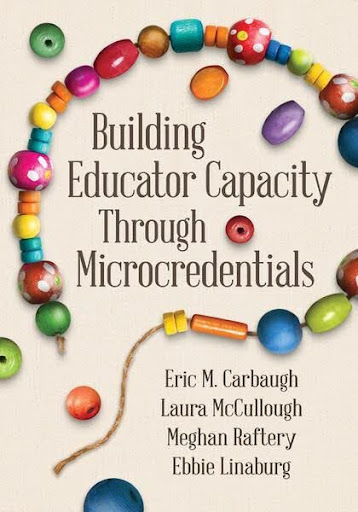
The article is called Boosting the Signal on Microcredentials: Aligning Stakeholder Goals and Values for Impactful Professional Learning and follows up on a book we wrote in 2021 called Building Educator Capacity Through Microcredentials.
We are submitting to Education Leadership for this call for submissions:
Great teaching deserves more than “drive-by” PD. This issue will examine how to transform professional learning from a passive experience into a dynamic, teacher-driven process that creates lasting impact in classrooms and boosts educators’ sense of efficacy and growth.
Our article argues that microcredentials—performance-based assessments that allow educators to demonstrate mastery of specific skills—have strong potential to transform professional learning, but they are not yet widely trusted or adopted in education. While other fields use short-term credentials as meaningful signals of skill and career readiness, K–12 education lacks consistent recognition, clear definitions, and aligned incentives.
To strengthen the “signal” of microcredentials, we argue that professional learning must meet the needs of three key stakeholder groups: educators, employers, and the broader educational ecosystem. When these groups share goals, microcredentials can become a powerful, credible indicator of educator competency.
The article outlines seven principles necessary for high-quality microcredential design and implementation:
- Work backward from data to identify meaningful professional learning goals.
- Ensure quality design with clear learning targets, resources, authentic tasks, and rubrics.
- Personalize pathways so educators can choose resources and task variations that fit their needs.
- Provide structured support, including feedback, check-ins, and deadlines.
- Encourage collaboration to prevent isolation and strengthen shared professional practice.
- Incentivize completion through career or financial benefits.
- Celebrate and publicize achievement to reinforce the value of demonstrated mastery.
Ultimately, the article calls for a shift from passive, compliance-driven professional development to personalized, competency-based learning that directly impacts students—and for microcredentials to serve as a credible, widely recognized signal of educator skill and growth.