
Allyship by Design
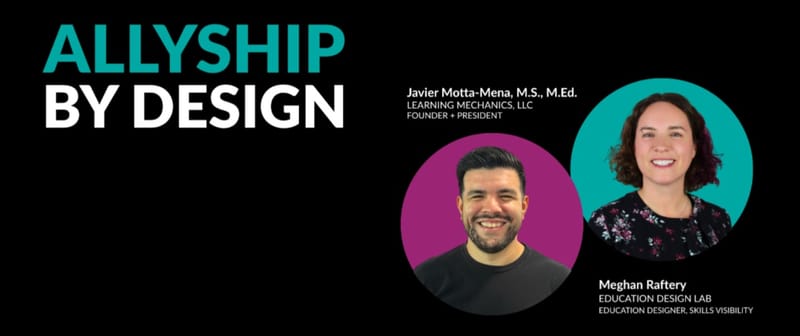
Ever since I saw Javier Motta-Mena present about this topic at The Badge Summit @ CU Boulder 2 years ago, I could not stop thinking about it and am so glad to have a place to record our thinking about it!
Neurodivergent students in higher ed are often handed an impossible choice: disclose and risk being stigmatized, or stay quiet and risk being written off as unreliable or checked out. Either way, the burden lands on them.
What if we stopped asking students to carry that?
That's the question Javier and I dig into in Allyship by Design — a podcast episode co-produced with Learning Mechanics and Education Design Lab. We make the case for treating neurodivergence allyship as a learnable, demonstrable skill — not just a value you claim to hold.
In this episode we get into:
- Why self-disclosure is such a high-stakes gamble — and why the system, not the student, should have to change
- How digital badges can give faculty and staff a verifiable way to signal genuine preparation, not just good intentions
- A case study where empathy simulation training led 80% of participants to voluntarily reflect on their own biases
This work sits at the intersection of inclusive design and skills validation — two things I care about deeply. I'm really proud of how this episode came together.
- Listen to the episode
- Companion guide and input form
- Register for the live follow-up discussion on 10 September
Made possible with support from Walmart, and with special thanks to Jeremiah Washington.
Coaching with Los Angeles Unified
I had the pleasure of spending 3 evenings in May with Los Angeles Unified Career and Technical Education teachers on behalf of Defined Learning.
Here's what Dr. Donna Stewart Lewis, CTE-Linked Learning Specialist and New Teacher Support for the Division of Instruction had to say about the recent session:
"Coaching Session #2 was awesome, and I really dig Meghan's facilitation style - smooth, calm, measured, kind, thoughtful, intentional and extraordinarily knowledgeable!"