Experience Matters: A Common Language for Talent, Trust, and Economic Mobility
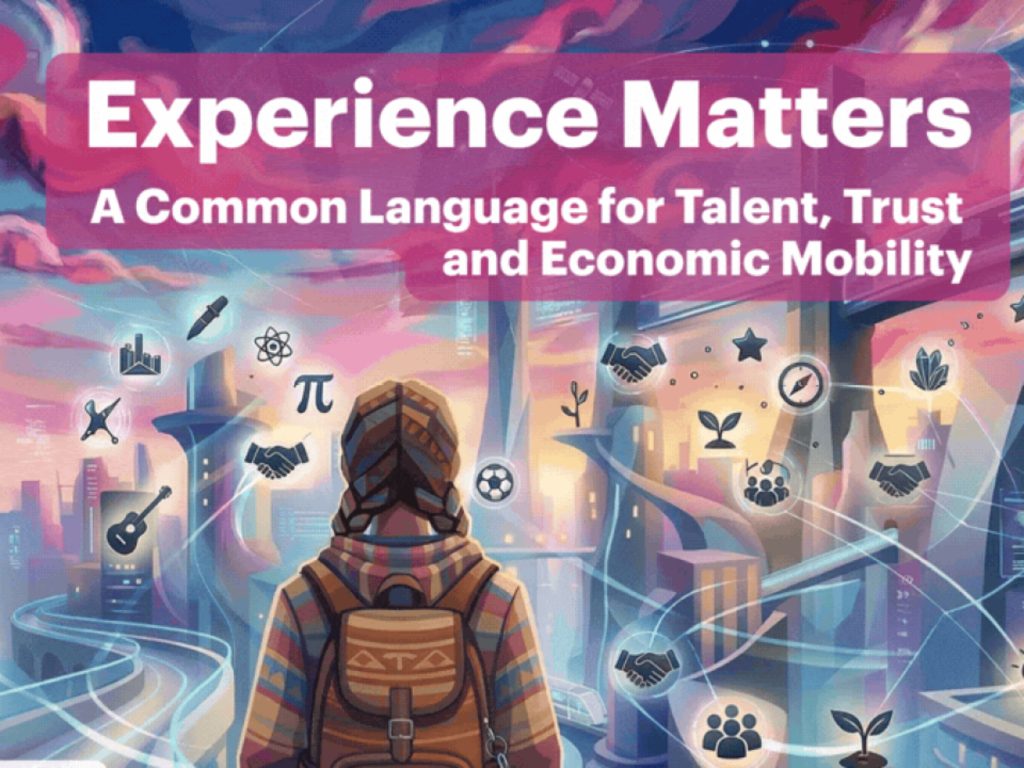
I recently co-authored a publication that’s been generating some real buzz in the field. “Experience Matters: A Common Language for Talent, Trust, and Economic Mobility” was produced in partnership with Getting Smart and Education Design Lab, and it tackles a problem I’ve been thinking about for a long time.
I’ve personally been exploring the leveling of durable skills for over 15 years, starting with the development of 21st Century skills for students in Virginia Beach City Public Schools, followed by developing future-ready skills with Defined Learning and Next Generation Scholars, all the way to working with Education Design Lab’s Durable Skills Framework today.
The Core Problem
You can’t get experience without a job. You can’t get a job without experience. And somehow we’re still surprised the talent pipeline is struggling.
This is what the report calls the “experience gap.” Employers increasingly require validated work experience for entry-level roles, but traditional documents like resumes and transcripts rarely capture what a learner actually knows and can do. They’re static. They’re often inaccurate. And they fail to provide the trusted, contextual evidence employers need to make confident hiring decisions.
The solution isn’t just new technology. It’s a new shared language.
A Shared Framework
The report proposes a Common Language of Experience built around three core anchors that can be used to design, evaluate, or describe any role, project, or experience:
- Autonomy: the level of independence, discretion, and supervision involved
- Complexity: the intricacy, novelty, and ambiguity of the challenge
- Contribution: the ability to mobilize others and impact outcomes
Each anchor is measured across a three-level progression: Follow (Level 1), Assist (Level 2), and Apply (Level 3). This framework moves beyond static proficiency models by focusing on the context of the skill, not just the skill itself. A learner demonstrating Level 3 Autonomy has initiated and managed their own work. That’s a different signal than someone at Level 1 following step-by-step instructions, even if they’d both claim the same skill on a resume.
Why I Care
We know that measuring durable skills is important, but the tools required are not the same ones we use for academic or technical skills.
Tough questions like how do we know a skill has been demonstrated, how much does context matter, and how can we agree on what quality looks like keep us from doing this work quickly, but the demand for this kind of information calls us to do the hard work.
AI tools that can quickly align skills frameworks and the appetite for out-of-school experiences make this the right moment for this work.
Who It’s Built For
One of the things I appreciate most about this framework is that it was designed for everyone in the system, not just one stakeholder.
For learners, it provides a structured way to reflect on and articulate their own growth. Instead of saying “I had an internship,” a learner using this framework can describe their actual level of independence, the complexity of what they navigated, and the impact they had on outcomes. That’s a story employers can trust and act on.
For employers, it shifts hiring from guessing about potential to verifying capability. The framework can be built directly into interview rubrics, giving hiring managers a precise, behavioral way to probe the scope of a candidate’s real experience.
For educators, it provides a shared blueprint for co-designing high-impact learning experiences with employer partners, and a new kind of rubric that captures the context of student capability, not just whether they completed a course.
The Infrastructure Behind It
For this to work at scale, the framework needs to be paired with digital infrastructure. The report outlines an evidence-driven credentialing pathway where learners gather evidence, that evidence is validated against the framework, and the resulting credential is stored in a portable digital wallet. The goal is a Learner Employment Record that functions as a trusted, verifiable, and equitable record of human capability.
This requires three commitments: expanding access so the system works for all learners including those on the margins, expanding the types of experiences that count, and expanding the value of these new credentials so that both learners and employers trust and use them.
What’s Next
This work doesn’t stop at the page. I’m co-presenting at an upcoming town hall with Getting Smart where we’ll dig into the findings and explore what it looks like to put this framework into practice.
The session, “Experience Matters: A Common Language for Talent, Trust, and Economic Mobility,” will walk through the interoperable framework built on the three core anchors and the three-layer implementation model of Evaluation, Design, and Storytelling. The goal is to show how this common language can empower learners with confidence while giving employers and educators a trusted, high-fidelity talent signal for the modern workforce.
Join us on April 8th at 10 AM PST. You can register and read the full report at gettingsmart.com/whitepaper/experience-matters.
Wrapping Up
The talent market has a broken feedback loop, and this publication offers a practical way to fix it. The core ideas are simple: experience has measurable value, learners deserve tools to articulate that value, and employers deserve trusted signals to act on it. When all three pieces are in place, the system works better for everyone.
This framework represents the kind of systemic thinking the field needs. It’s not about replacing degrees or credentials. It’s about building a more complete, more honest picture of what people know and can do.
If this work resonates with you, I’d love to connect.